
There are many purchases in your life that require a substantial amount of research prior to making a final decision. This process can be tedious and overwhelming, almost enough to make any power-shopper throw in the towel. Buying a new pool cue does not have to be one of those items.
Whether you're choosing a cue for yourself or as a gift for someone, here are five key things to keep in mind that will aid in your endeavor.
Key Takeaways
- You don’t need to spend a lot of money to get a good pool cue. Matching your budget to your goals and skill level is the best approach.
- Dependable beginner cues start around $100. There is a considerable increase in performance (low-deflection) at the $300 mark and professional grade pool cues start around $600 for base models.
- Investing more in a pool cue based on performance will help you improve faster and may even save money in the long run.
- The standard length of a pool cue is 58 inches and 19oz is the preferred weight for most players. A tip diameter between 12.5mm - 13mm is ideal for balancing spin with forgiving playability.
- After setting a budget and performance level, look at the overlapping brands to see which styles and finishes speak to you to pick the perfect pool cue.
1. BUDGET - FIND THE RIGHT CUE WITHOUT BREAKING THE BANK.
For many of us, the type of cue we purchase may be based on the size of our pocketbooks. Well, rest assured. Finding the right cue doesn't have to break the bank. Your game WILL benefit from the consistency of any two-piece maple pool cue when compared to playing with wobbly, beat-up, old house cues. When setting your budget, a player's skill level should be considered for determining the appropriate cost of the new cue.
2. SKILL LEVEL - CONSIDER HOW SERIOUS THE PLAYER IS.
Most beginner players can find a dependable starter cue in the $100 range. Once a player starts competing in either leagues or tournaments, they may want to consider upgrading to something with a little more meat.
Your skill level is a useful starting point when choosing a pool cue, but that is not the only factor to consider. These tiers can help you narrow down your options based on your experience, the features you are looking for, and the budget that works for you.
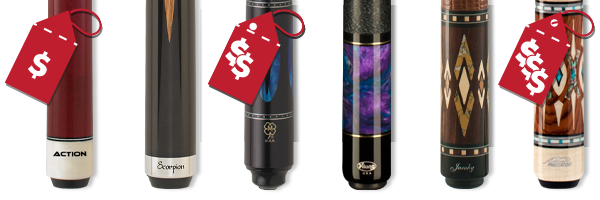
- $75-$299 (Beginner): Reliable construction, traditional maple shafts, and a wide variety of designs make these cues a good choice for casual players, beginners, and anyone buying their first pool cue. Most cues in this range come standard with a 12.75mm -13mm maple shaft, providing a solid starting point for developing your game. Brands include Action, Athena, Elite, Outlaw, and Talon.


- $300-$599 (Intermediate): This is where low-deflection shaft technology starts becoming more common, with many models featuring higher-performance shafts designed to help league and tournament players take their game to the next level. Many cues in this range also start to use more exotic woods, true inlays in their designs and more tip size options to match your playing style. Brands include Cuetec AVID, Scorpion Carbon Fiber, McDermott, Katana, Lucasi, and Pechauer.


- $600+ (Expert): If you want a professional-grade pool cue, budget for this range. They feature some of the most advanced low-deflection shaft technology, premium materials, and high-performance construction available. Many models also offer premium carbon fiber shaft options, giving players more choices in feel, consistency, and performance. Brands include Predator, Meucci, Jacoby, Bull Carbon, and Cuetec Cynergy.


Once you know your budget, browse our full cue selection to compare options in your range.
3. PERFORMANCE - PICK A CUE THAT DOES WHAT YOU NEED IT TO.
The more serious the player, the more sophisticated the cue technology may require. Predator cues come standard with a low-deflection shaft which is designed to increase accuracy and performance. This is my personal favorite brand when it comes to the low-deflection products. Other makes that also produce a comparable product include: CueTec Cynergy, McDermott and Meucci. Watch this video to learn more about cue ball deflection so you can decide if that technology would be right for your game!!
If the player does not require a high-performance cue, most cues (unless otherwise indicated) come standard with a traditional maple shaft. To increase performance and the life of the cue, never store your cue in the leaning position or in extreme hot or cold conditions.
Cue Tip Basics
Pool cue tip diameters typically range from 11mm to 13mm, with 13mm being the most popular size and a forgiving choice for beginners. As players develop their technique and preferences, many choose a smaller tip diameter for more precise cue-ball control. Tip hardness also affects play: softer tips grip the cue ball for added spin, while harder tips feel firmer and tend to hold their shape longer.
4. STYLE - CHOOSE A LOOK THAT FITS THE PLAYER'S PERSONALITY.
When debating on fashion over function, consider the level of the player (and your budget). Once you’ve determined the price range, skill level, and performance features you’re looking for, you can narrow your choices to the styles you like. Generally, when within certain price ranges, the quality of the cue does not vary much. The difference in price then applies more to fashion over function.
Here are some good style options for cues under $200:


If you're someone that needs the "Latest and Greatest" equipment or something that will make others drool with envy, you might lean toward the higher end styles:


5. WEIGHT/BALANCE - SELECT THE RIGHT WEIGHT AND BALANCE.
Now that you've found a cue that you love, what's the right weight and balance? Most cues are anywhere between 18 to 21 ounces in weight. That's right, the number you see indicates the total weight of the completely assembled cue. Most house cues are built with most of the weight in the butt of the cue. If the shooter is vertically challenged with a shorter-than-average arm span (like myself), a house cue will feel "butt heavy" and innately cause two possible things to happen: (1) the player will tend to grip the cue too far back to compensate, or (2) the player's tip will pull up during the follow-through due to the excess weight in the back.
If you're on the shorter side, look for a cue that is more forward-weighted. In production cues, the weights in the butt are designed to be easily added or removed. Therefore the balance may vary based on the total weight of the cue. 19oz is the most popular and ideal weight in the back. A 19-ounce cue is a common starting point for most players. Lighter cues can feel quicker and more responsive, while heavier cues tend to provide a firmer, more solid feel through the stroke.

As a player improves and gets more and more serious, there may be a need for a designated breaking or jumping cue. These feature special technology for their respective functions and should require some research on their own. So, if you're in the market for a new pool cue either for yourself or for someone else, consider these five things and spend more time playing with the cue rather than shopping for it.
FAQs
What cue length should I choose based on my height?
A 58-inch cue is standard for most adult players. Shorter players may prefer a shorter cue, while taller players can use an extra-long shaft or extension when additional reach is needed.
Should I buy a one-piece or two-piece cue?
A two-piece cue is the most versatile choice for most players because it is easier to transport without sacrificing performance. One-piece cues are a good option if you primarily play at home.
Which tip size and hardness are best for beginners?
A 13mm medium tip is a popular starting point because it offers a forgiving contact area and a good balance of control and spin. Softer tips provide more grip and spin, while harder tips feel firmer and hold their shape longer.
How much should a good pool cue cost?
Good cues are available at every price range. The right budget depends on what features, materials, construction, and performance you are looking for and how much you want to spend.