One of the hardest things for new pool players to grasp and utilize is putting English on the cue ball. The whole idea of English makes sense, but in practice it can be difficult to understand and recall, especially in the middle of a tight match. That's why we put together this handy dandy little chart to show you the different places to hit the cue ball and how they will change the spin, trajectory and overall behavior of the cue ball. Keep in mind that this chart does not take speed and power into consideration, as the amount of English you put on the ball will change depending on how hard you hit the ball.
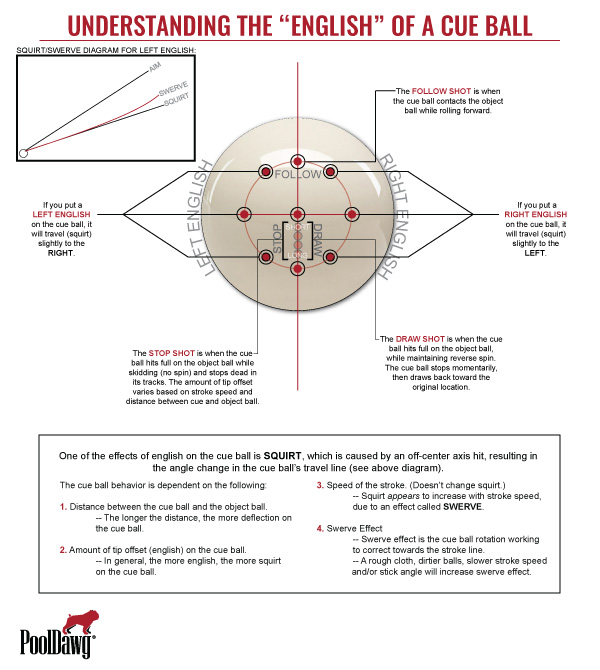
For more help learning how to add English to your cue ball, check out some of the training cue balls we offer
Related Articles:
Should I Use A Low Squirt (Deflection) Shaft?
Is There Such A Thing As Draw Induced Throw?
How Can I Master the Stop Shot?
Embed Understanding English on Your Site: Copy and Paste the Code Below
a month for 9 months of the year for about 9-10 guys.
I have a question about using English on the cue ball. Should the Cue Stick tip be angled towards the side of the Cue ball or should the entire Cue Stick be moved slightly to the right or left so as to leave the forward force straight on. (hope this makes sense). I see some angle the cue stick to hit the English position, I tend to move the entire cue stick right or left a bit so as to be still inline with the direction I am aiming? / vs I
Thanks so much, Roger
I think that the horizontal shift and the pivot method are both valid ways to apply English to the cue ball depending on the shot. There are a lot of factors and too much for me to explain consisely. I'd recommend checking out Dr Dave's answers on English, specifically "back hand/front hand English" and "parallel English" as he's going to be able to explain it with much better detail.